
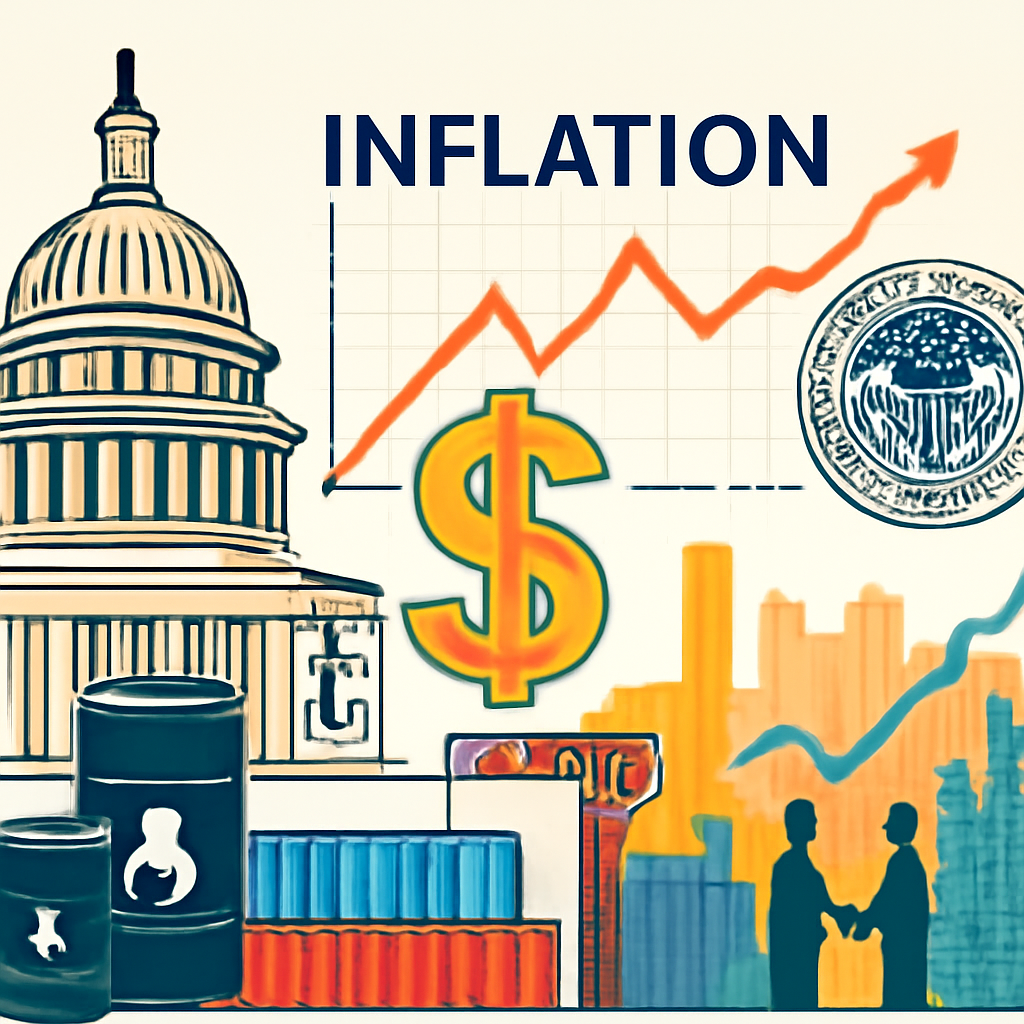
us policy inflation has become a serious topic for economists and investors because decisions made in Washington increasingly ripple through global markets and land in consumer prices elsewhere, especially in large import-dependent economies like India. Recent signals from the U.S. Federal Reserve, shifting trade tariffs, higher fiscal deficits, and renewed geopolitical pressure on energy routes have all combined to keep inflation risks alive globally. Even when India’s domestic demand is stable, imported cost pressures can rise if the dollar strengthens, crude oil becomes expensive, or foreign capital turns volatile after a major U.S. policy shift.
The timing of this debate matters. In the latest global market cycle, inflation in many advanced economies has cooled from its peak, yet price stability remains fragile. The U.S. has kept interest rates restrictive for longer than many expected, while political pressure around tariffs, industrial subsidies, and supply-chain security has intensified. For India, which imports a large share of its crude oil, electronics components, fertilizers, and other intermediate goods, such moves do not remain foreign-policy headlines for long. They can show up in fuel bills, transport costs, factory input prices, and eventually food and retail inflation.
How us policy inflation travels across borders
There is no single channel through which U.S. decisions affect India. Instead, the spillover works through four main routes: the dollar, commodity prices, capital flows, and trade costs. If U.S. interest rates stay high, global money often shifts toward U.S. assets, strengthening the dollar. A stronger dollar can make imports more expensive for India, even if the underlying commodity price does not surge dramatically. At the same time, many internationally traded goods, especially oil, are priced in dollars, which amplifies the effect.
Trade policy is another important route. If the U.S. raises tariffs on key goods or tightens rules in the name of strategic security, suppliers may redirect trade, increase compliance costs, or rebuild supply chains more slowly. That can push up global manufacturing costs. Countries like India may benefit in some sectors as firms diversify away from China, but in the short term the transition is often inflationary. Production networks become less efficient before they become more resilient, and that inefficiency can be costly.
us policy inflation and the dollar problem
The dollar remains central to global inflation transmission. When U.S. rates remain elevated, the yield on American assets becomes more attractive, drawing global capital into the U.S. This can weaken emerging-market currencies relative to the dollar. For India, a weaker rupee raises the landed cost of imports, from crude oil to machinery and semiconductors. Even if Indian companies absorb part of the shock, margins tighten and later get passed on to consumers. That is why currency stability often becomes a key anti-inflation tool for the Reserve Bank of India.
A strong dollar also tightens financial conditions beyond trade. Indian firms with foreign currency liabilities may face higher repayment burdens, and portfolio outflows can increase bond-market volatility. When governments and central banks react by defending currency stability, domestic liquidity can tighten. That may help contain inflation eventually, but it can also raise borrowing costs across the economy. In other words, a U.S. anti-inflation stance can unintentionally export inflationary pain first and disinflationary pressure later.
Energy markets are the clearest transmission channel
For India, oil is often the most visible link between U.S. policy and inflation. American sanctions, geopolitical signaling, strategic reserve actions, and diplomatic positioning in oil-producing regions can all affect global crude prices. Even when the U.S. is itself a major energy producer, its foreign-policy stance still influences supply expectations, shipping risks, and speculative trading behavior. Higher crude prices quickly feed into India’s transport costs, logistics, aviation fuel, plastics, chemicals, and fertilizer production.
The effect is broader than petrol and diesel. Costlier energy raises the operating expense of moving food, running factories, cooling warehouses, and powering urban services. If monsoon patterns are uneven at the same time, food inflation can become stickier. This is why policymakers in India watch not just domestic harvests and wages, but also U.S. sanctions policy, maritime security developments, and energy diplomacy. Inflation in India is often a blend of local supply issues and external commodity shocks, and the external part can begin with U.S. decisions.
Latest developments shaping inflation risks
Recent market attention has centered on three trends: the possibility of U.S. rates staying higher for longer, a harder line on tariffs and industrial policy, and persistent geopolitical frictions affecting shipping and energy. Higher-for-longer rates keep the dollar firm. New tariff threats can raise input costs for global manufacturers. Shipping disruptions, especially when linked to security tensions, increase freight and insurance expenses. India may not be the target of these policies, but it still pays part of the bill as an integrated trading economy.
Another recent issue is the scale of U.S. fiscal spending and debt issuance. Large borrowing needs can keep bond yields elevated, reinforcing dollar strength and global rate pressure. That matters because emerging markets must compete for capital. If investors can earn attractive returns in relatively safer U.S. bonds, money can move out of riskier markets. The result for India may be currency pressure, higher imported costs, and tighter domestic financial conditions, all of which complicate the inflation outlook.
Why India feels the pressure differently
India is not uniquely vulnerable, but its inflation profile makes external shocks especially important. Food has a larger weight in household spending than in many advanced economies, and fuel costs affect nearly every supply chain. A rise in imported energy costs can therefore spread more widely and quickly. At the same time, India is growing fast, urbanizing rapidly, and investing heavily in infrastructure, which raises demand for energy, metals, and imported capital goods. That combination can magnify the impact of global price moves.
Still, India has some buffers. Foreign exchange reserves, a diversified import strategy, digital tax systems, and better monetary credibility than in earlier decades have improved resilience. India has also expanded trade relationships and increased purchases from multiple energy suppliers. These steps reduce vulnerability, but they do not eliminate imported inflation. If U.S. policy keeps the dollar high and global commodities volatile, India can only partly cushion the shock through reserves, fuel taxes, or targeted subsidies.
What Indian policymakers can do
- Stabilize the rupee through calibrated intervention to reduce abrupt imported inflation.
- Manage fuel taxes smartly so temporary global spikes do not fully pass through to consumers at once.
- Diversify energy imports and expand renewables to lower exposure to external oil shocks.
- Protect food supply chains with storage, logistics, and timely imports when domestic supply is hit.
- Maintain policy credibility so inflation expectations do not become entrenched.
Can U.S. actions also help India over time?
Yes, but the benefits are uneven and slower than the inflation shock. U.S.-China tensions and subsidy-led industrial policy have encouraged companies to diversify manufacturing bases. India can gain from this shift through electronics, pharmaceuticals, defense supply chains, and digital services. However, the transition period often raises costs because firms duplicate capacity, comply with new rules, and accept less efficient sourcing. That means the long-run strategic benefit to India can coexist with near-term imported inflation.
The deeper lesson is that inflation in emerging economies is no longer only about domestic money supply or local harvests. It is increasingly shaped by the policy choices of large economies, especially the United States. us policy inflation is therefore a useful lens for understanding why prices in India can rise even when domestic demand appears under control. As long as U.S. rates, fiscal choices, trade restrictions, and energy diplomacy remain powerful forces in global markets, India will have to manage inflation as both a local and international challenge.
Conclusion: a global inflation chain
India’s inflation story cannot be read in isolation. U.S. monetary policy influences the dollar, U.S. fiscal choices affect global yields, U.S. trade actions reshape supply chains, and U.S. geopolitical decisions move energy markets. Each link in that chain can raise costs for Indian households and businesses. The most realistic view is not that America single-handedly creates inflation abroad, but that its policies can amplify existing pressures. For India, staying resilient means building domestic buffers while preparing for a world where external policy shocks arrive faster and transmit more directly than ever before.
Leave a Reply