
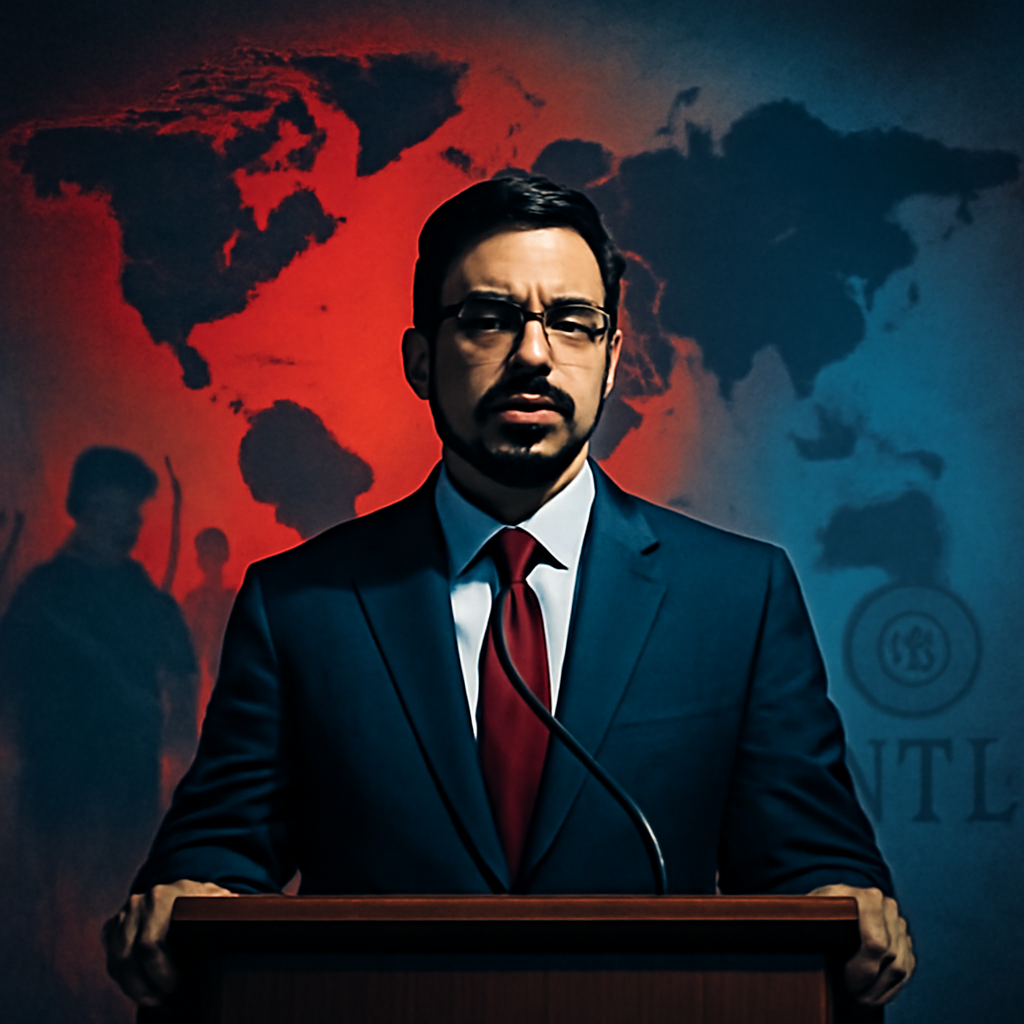
us aggression has moved back to the center of global debate after Najeem M Illyas forcefully rejected what he described as Washington’s growing attack-and-suppress doctrine. In a sharply worded response to recent US military signaling and interventionist rhetoric, Illyas argued that fear, whether framed as deterrence, preemption, or national security anxiety, cannot become a moral license for escalation. His central message was blunt: states that normalize force in the name of insecurity often create the very instability they claim to prevent.
The timing of Illyas’s remarks is significant. Across several conflict theaters, the United States has been accused by critics of relying on a familiar sequence: identify a threat, expand military posture, justify exceptional action, and then present suppression as a necessary condition for peace. Supporters call this strategic realism. Opponents say it is an old doctrine repackaged for a more fragmented world, one in which unilateral action carries wider diplomatic, humanitarian, and economic consequences than before.
us aggression and the politics of fear
Illyas’s criticism goes beyond one strike, one speech, or one administration. He appears to be challenging a broader mindset in US power projection, especially the assumption that fear of future danger justifies present violence. According to this view, governments can portray uncertainty itself as evidence, turning risk assessments into operational permission. Illyas contends that this logic is dangerous because it lowers the threshold for action while raising the tolerance for civilian harm, regional backlash, and legal ambiguity.
That argument resonates in the current news environment, where anxieties over regional spillover, proxy warfare, shipping routes, and strategic deterrence have intensified. In Washington, policymakers often defend robust action as a way to restore credibility and prevent adversaries from testing limits. Yet critics increasingly ask whether repeated demonstrations of force have actually restored order, or whether they have instead entrenched cycles of retaliation that make diplomacy more difficult and political compromise more costly.
us aggression in current strategic doctrine
The attack-and-suppress approach, as described by its critics, rests on the belief that overwhelming capability can contain crises before they spread. In practice, however, such doctrine often mixes military punishment with political messaging, producing results that are hard to measure and harder to sustain. Illyas warned that when force becomes the first language of policy, states begin to confuse suppression with stability. A quiet battlefield may look like peace in the short term, but unresolved grievances, damaged institutions, and public anger remain active beneath the surface.
Recent developments across the Middle East and other contested regions reinforce the concern. US operations, force deployments, and defensive justifications are frequently linked to immediate security needs, but those moves also reshape local calculations. Allies may feel emboldened, rivals may harden positions, and non-state actors may gain recruitment narratives. This is why Illyas’s statement has drawn attention beyond the headline itself: he is addressing the structural consequences of doctrine, not simply the optics of one confrontation.
us aggression and international law
A major part of the criticism centers on legality. International law permits self-defense under narrow conditions, but critics say modern strategic language often stretches those conditions to accommodate preventive or loosely defined threats. Illyas argued that if fear is accepted as sufficient justification, then legal restraint becomes vulnerable to political interpretation. The danger is not only that one country acts too broadly, but that others will adopt the same reasoning. Once that precedent spreads, the global system becomes less rule-based and more power-based.
This concern matters because legal standards are not abstract diplomatic decorations. They shape how smaller states assess risk, how international institutions react, and how conflicts are documented in the court of public opinion. If leading powers appear selective in their respect for norms, they weaken their own ability to rally support when rivals violate those same norms. Illyas’s criticism therefore strikes at a deeper issue: credibility in foreign policy depends not only on strength, but also on consistency.
Why Illyas says suppression is not peace
At the heart of Illyas’s position is a distinction between control and resolution. Suppression can interrupt an attack, degrade an adversary, or temporarily impose order. But it does not automatically solve the political conditions that produced confrontation in the first place. This is particularly relevant in environments shaped by occupation, sanctions pressure, internal fragmentation, sectarian distrust, and external patronage. In such settings, a military response may change the map of risk without changing its source.
That critique also connects with a wider shift in public discourse. Audiences are increasingly skeptical of official narratives that promise limited action, rapid deterrence, and minimal fallout. Recent history has shown how quickly supposedly calibrated operations can expand into broader crises. Illyas’s remarks tap into that skepticism by insisting that fear-driven doctrine tends to overpromise control while underestimating blowback. For analysts watching current tensions, that warning feels especially relevant.
Regional fallout and diplomatic costs
Another reason the statement is gaining traction is its emphasis on second-order effects. Military action does not occur in a vacuum; it affects alliance politics, energy markets, domestic legitimacy, investor confidence, and humanitarian conditions. Even where US officials frame operations as precise and defensive, affected populations often experience them as part of a longer architecture of coercion. Illyas appears to be arguing that this perception gap is itself strategic fuel, because resentment can outlast tactical success and spread across borders through media, migration, and political mobilization.
Diplomatically, repeated reliance on force can narrow policy options. Partners may publicly support Washington while privately urging restraint. Competitors can exploit each strike to reinforce their own narratives about American hegemony. Neutral states may become less willing to endorse sanctions, mediation formats, or joint statements if they believe coercion is crowding out negotiation. In that sense, the attack-and-suppress doctrine may generate diminishing returns: more military effort, less political leverage.
What this means for US policy next
Illyas is not merely condemning policy language; he is challenging the strategic culture behind it. If his argument gains wider traction, the debate will shift from whether a particular action was effective to whether the doctrine itself is sustainable in a multipolar era. The central question becomes whether the United States can protect interests without treating every emerging threat as a justification for immediate dominance. For many observers, that is now the real test of leadership.
- First, fear-based framing can expand military discretion faster than democratic oversight can respond.
- Second, short-term suppression may deliver headlines of control while worsening long-term instability.
- Third, legal flexibility used by major powers can weaken international norms for everyone else.
- Fourth, diplomacy loses credibility when coercion appears to be the default opening move.
The likely impact of Illyas’s comments will depend on whether broader political and media circles engage the substance of his warning. If the conversation remains confined to partisan reactions, the deeper critique may be lost. But if policymakers, scholars, and civil society actors examine the assumptions behind fear-driven intervention, the statement could become part of a larger reassessment of how power is used and justified. In an era of overlapping wars and fragile deterrence, that reassessment is overdue.
Ultimately, Illyas’s line that fear is no excuse for aggression is powerful because it cuts through strategic euphemism. It challenges the conversion of anxiety into doctrine and doctrine into repeated force. Whether one agrees with every aspect of his critique or not, the question he raises is unavoidable: does security come from suppressing threats faster, or from building a framework in which fewer actors believe force is their only language? For a world already strained by escalation, that is not just a rhetorical question. It is the policy debate that may define what comes next.
Leave a Reply