

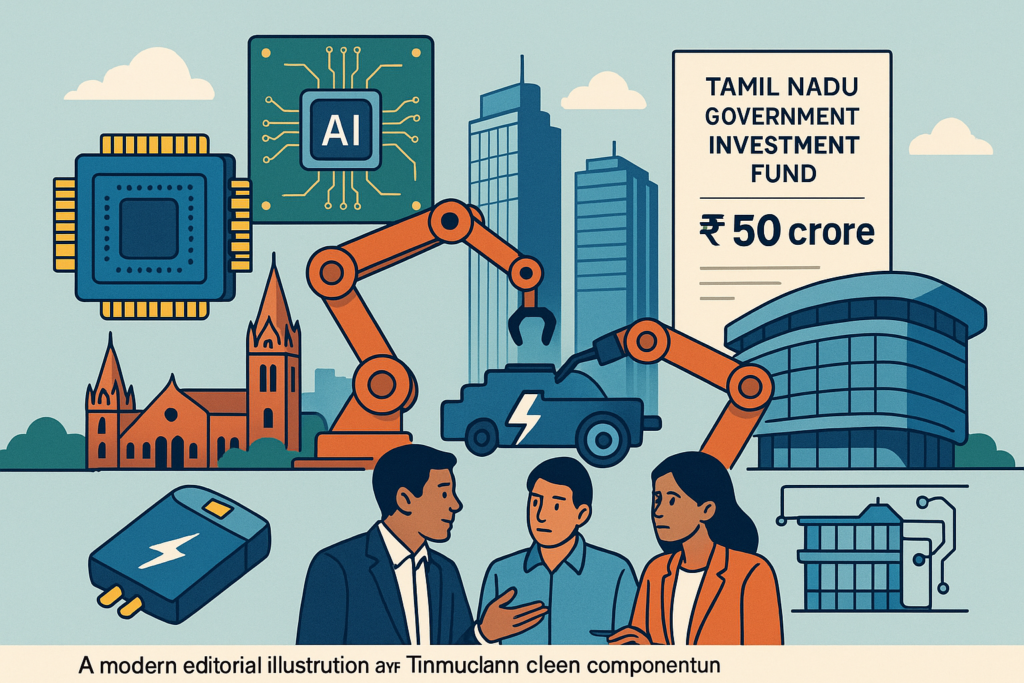
tidco startup fund is more than a new pool of capital. TIDCO’s proposed ₹50 crore investment vehicle signals that Tamil Nadu wants a stronger role in shaping the next generation of deep-tech companies rather than merely hosting service-led startups. The move matters because deep-tech businesses typically need patient capital, access to industrial infrastructure, and credibility with large buyers. By stepping in early, the state is effectively saying that advanced manufacturing, electronics, mobility, climate technologies, and frontier engineering should become part of Tamil Nadu’s future economic identity.
Why tidco startup fund matters now
India’s startup conversation has often been dominated by software, consumer internet, and quick-scaling digital platforms. Deep-tech follows a different path. It takes longer to build, needs stronger research links, and usually depends on prototypes, testing cycles, regulatory clearances, and manufacturing partnerships. That is exactly why state-backed capital can be catalytic. Tamil Nadu already has strengths in automobiles, electronics, aerospace components, precision manufacturing, and higher education. A targeted fund can connect these strengths to startups working on hard problems, helping them cross the difficult gap between lab-stage innovation and commercial traction.

tidco startup fund and the state’s industrial logic
TIDCO is not entering this space as a passive financial investor. Its broader role in industrial development gives it a strategic advantage that many venture funds do not have. It understands land, infrastructure, industrial clusters, public-private partnerships, and the needs of global manufacturers looking to expand in Tamil Nadu. If structured well, the fund can do more than write cheques. It can help portfolio companies find pilot customers, manufacturing sites, supply-chain partners, and policy support. That kind of integrated backing is especially valuable for startups building hardware, materials, energy systems, med-tech devices, or industrial software tied to physical operations.
What makes deep-tech investing different
Unlike conventional startup investing, deep-tech funding requires tolerance for technical risk and delayed returns. A company building battery systems, industrial automation tools, semiconductor design assets, or advanced sensors may take years to mature. However, such firms can create defensible intellectual property, skilled employment, and strategic capabilities that last longer than short-cycle digital products. For Tamil Nadu, the benefit is not just financial upside. Deep-tech champions can anchor local supplier networks, create export opportunities, and improve the state’s position in critical sectors where India wants greater self-reliance.
The economic case for Tamil Nadu
Tamil Nadu is already one of India’s most industrialized states, with strong export orientation and a broad manufacturing base. The challenge now is moving up the value chain. Competing only on cost is not enough in a world shaped by automation, energy transition, smart mobility, and advanced electronics. The state needs companies that can design, patent, and produce differentiated technologies. A ₹50 crore fund alone will not transform the ecosystem, but it can serve as an important market signal. It tells founders, universities, family offices, and larger investors that Tamil Nadu is serious about nurturing innovation-led enterprises with long-term strategic importance.
Likely areas where the fund could create impact
- Mobility and EV technologies: battery systems, power electronics, charging hardware, lightweight materials, and fleet intelligence.
- Electronics and semiconductors: design tools, embedded systems, component innovation, testing platforms, and specialized manufacturing support.
- Industrial automation: robotics, machine vision, predictive maintenance, and factory digitization aligned with the state’s manufacturing depth.
- Climate and energy: clean energy systems, storage, grid technologies, water efficiency, and industrial decarbonization solutions.
- Health and life sciences engineering: diagnostic devices, med-tech hardware, bioengineering platforms, and hospital technology tools.
These sectors align with Tamil Nadu’s industrial base and can benefit from close proximity to factories, technical talent, and export infrastructure. The better the alignment, the stronger the chance that startups can scale from concept to commercial adoption without leaving the state.
What success will depend on
Capital is necessary, but design will decide whether the initiative creates real outcomes. First, the fund needs a clear mandate: early-stage support, scale-up capital, or strategic co-investment. Second, investment decisions should be led by professional expertise rather than bureaucracy, with room for technical diligence and faster execution. Third, startups need pathways to pilots and procurement. A state-backed fund becomes far more powerful when public agencies, industrial parks, universities, and large corporates create demand-side opportunities. Finally, follow-on funding matters. If promising firms cannot raise the next round, the ecosystem will still struggle to produce durable champions.
Risks investors and founders should watch
There are also real risks. Publicly linked funds can become too conservative, spreading small investments across too many companies instead of backing the strongest ones with conviction. They may also prioritize optics over specialization. Deep-tech cannot be built through broad slogans alone; it requires domain knowledge, patient timelines, and realistic expectations. Another challenge is founder support. Many engineering-led teams are technically capable but need help with go-to-market strategy, regulatory navigation, pricing, and global partnerships. Unless the fund is paired with mentorship and industry access, the capital may not unlock its full potential.
Why this could reshape the startup map
If executed well, the TIDCO initiative could help rebalance India’s startup geography. For years, startup capital has clustered around a few large ecosystems, often favoring software-first models. Tamil Nadu has the ingredients to build a different template: one rooted in engineering, factories, applied research, and export-led growth. A successful state-supported deep-tech platform could encourage more founders to stay local, attract national venture firms to co-invest, and inspire similar strategies in other industrial states. In that sense, the significance of the ₹50 crore bet lies less in its size and more in the signal it sends about the type of companies Tamil Nadu wants to create.
Final analysis
TIDCO’s ₹50 crore startup bet should be viewed as a strategic industrial move rather than a standalone funding announcement. It reflects a broader understanding that the next wave of economic growth will come from technology embedded in products, factories, mobility systems, energy networks, and critical infrastructure. Tamil Nadu already has many of the foundational assets required to lead in that transition. The real test is whether the fund becomes a disciplined platform for identifying ambitious founders, de-risking early innovation, and linking startups to the state’s industrial engine. If that happens, Tamil Nadu may not just fund startups; it may build the deep-tech champions that define its next decade.
Leave a Reply