
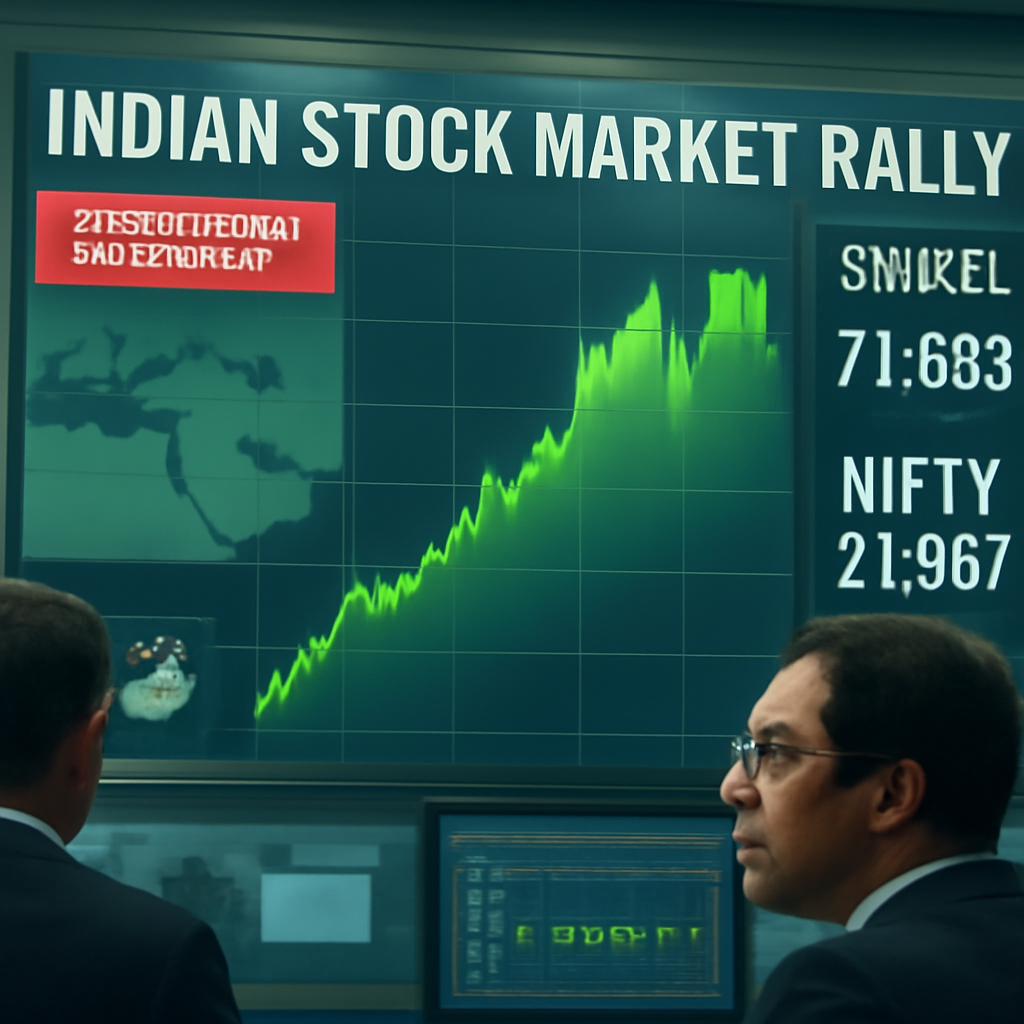
iran us ceasefire became the biggest trigger for market sentiment as Indian equities staged a sharp rebound of nearly 3.7% within half a trading day. The sudden improvement in risk appetite came after reports of a temporary pause in tensions between Iran and the United States, calming fears of a wider regional conflict. For investors in India, the immediate takeaway was simple: lower geopolitical stress usually means reduced pressure on crude oil, improved foreign investor mood, and a stronger appetite for cyclical and high-beta stocks. That combination produced an unusually strong intraday move across benchmark indices and sector leaders.
The rally was broad rather than narrow, which made the move more significant. Banking stocks led from the front, large-cap IT names participated, metals gained on hopes of firmer global demand, and oil-sensitive sectors found relief as crude risk premium expectations softened. Market breadth remained positive through the first half of the session, showing that this was not just a short-covering spike in a handful of heavyweight stocks. Traders also reacted to the possibility that a cooling of hostilities could stabilize shipping routes, reduce energy uncertainty, and improve confidence across emerging markets, with India becoming a key beneficiary.
How iran us ceasefire changed market mood
Geopolitical shocks tend to hit markets through three channels: energy prices, currency volatility, and investor risk perception. In this case, the temporary ceasefire signal reduced the probability of an immediate escalation that could have disrupted regional supply chains or pushed oil prices sharply higher. Because India is a major crude importer, any easing in oil-related fear quickly improves the outlook for inflation, corporate margins, and the current account. That is why domestic investors as well as foreign portfolio participants turned aggressive buyers once the news flow shifted toward de-escalation.
The timing also mattered. Indian markets had been trading with elevated caution amid uncertain global cues, and valuations in several frontline stocks had already corrected from recent highs. When geopolitical pressure eased, traders used that opening to rebuild long positions. Such moves are often amplified in the first half of a trading session because derivatives positioning, stop-loss triggers, and algorithmic strategies all respond to a rapidly changing risk environment. The 3.7% move was therefore not only a reaction to headlines, but also a reflection of how tightly positioned the market had become before the relief emerged.
iran us ceasefire and Indian markets: key drivers
Oil, rupee and inflation expectations
One of the clearest links between Middle East developments and Indian assets is crude oil. If traders believe a ceasefire can hold, even temporarily, the risk premium in oil prices tends to cool. That helps the rupee by reducing external pressure, and a steadier rupee in turn supports import-heavy sectors and eases concerns about inflation. Lower inflation anxiety can improve the outlook for interest rates, consumption, and profitability, which is why financials, autos, aviation-related names, and consumer plays often react quickly to such news.
Foreign flows and risk-on positioning
Global funds typically move toward emerging markets when uncertainty falls and volatility expectations recede. India often attracts a large portion of those flows because of its liquidity, policy visibility, and depth across sectors. A temporary ceasefire between Iran and the US signaled, at least for the moment, that worst-case scenarios were less likely. That helped trigger a risk-on trade, with large-cap banks and index heavyweights seeing strong buying interest. Institutional investors also prefer clarity, and even a temporary pause in tensions can be enough to shift allocation decisions over the short term.
Which sectors gained the most in the rally
Banking and financial stocks were among the biggest gainers because they are highly sensitive to changes in macro confidence. If oil remains contained and inflation risks ease, expectations for credit growth and asset quality stability improve. IT stocks also benefited as broader global sentiment turned constructive, while metals and industrials advanced on hopes that calmer geopolitical conditions could support international trade and commodity demand. Energy shares moved in a more mixed manner, as upstream companies can benefit from high crude prices, but the broader market preferred sectors that gain from lower input cost pressure.
Midcaps and smallcaps also participated, which gave the rally additional credibility. In many relief-driven moves, only benchmark constituents rise while the broader market remains weak. Here, buying spread beyond just the index giants. That said, sharp intraday gains can also bring profit-booking later in the session or over the next few days, especially if there is no follow-through from global markets. Investors should therefore distinguish between a sentiment-led bounce and a durable trend reversal. Sustainability will depend on whether the ceasefire holds and whether macro indicators continue to support risk assets.
What investors should watch after iran us ceasefire
The first variable to monitor is whether the ceasefire remains intact. Markets react fast to de-escalation headlines, but they can reverse just as quickly if tensions flare again. The second is crude oil behavior. If oil remains stable or drifts lower, Indian equities may retain support, particularly in rate-sensitive and consumption-linked sectors. The third is foreign institutional investor activity. A few sessions of consistent inflows would suggest that the rally has stronger legs than a one-day reaction. Currency movement, bond yields, and comments from global policymakers will also shape the next phase.
Domestically, investors should track whether leadership remains broad-based. A healthy rally usually sees participation from banks, autos, IT, capital goods, and select consumption names. If the advance narrows too quickly, that may indicate short covering rather than fresh conviction. Traders should also keep an eye on volatility indices and derivatives data, because options positioning can reveal whether the market expects continuation or consolidation. For long-term investors, the larger lesson is that geopolitical events can create sudden dislocations, but disciplined asset allocation and staggered buying remain more reliable than chasing every headline-driven spike.
Short-term outlook for Sensex and Nifty
After a 3.7% rise within half a day, the immediate outlook becomes a balance between momentum and cooling. Strong rallies often face resistance near technical levels where traders choose to lock in gains. However, if overseas markets stay positive and oil prices remain contained, Indian benchmarks could try to hold much of the advance. The quality of the move will depend on volume, institutional participation, and whether defensives also join the uptrend. A market that digests gains without sharp selling is usually healthier than one that spikes and fades.
For now, the message from Dalal Street is clear: reduced geopolitical risk can quickly reprice Indian equities upward because the economy is highly sensitive to energy costs and global capital flows. The temporary Iran-US ceasefire may not solve the larger strategic issues in the region, but it has already shown how strongly sentiment can shift when the risk of escalation recedes. As always, investors should remain alert, diversify across sectors, and avoid assuming that one headline guarantees a straight-line rally. Still, the half-day 3.7% jump underlines the market’s confidence that any easing in conflict risk is a material positive for India.
- Big trigger: Relief over a temporary Iran-US ceasefire improved global and domestic risk sentiment.
- Main market impact: Indian benchmark indices surged about 3.7% within half a trading day.
- Key transmission channel: Easing crude oil fears supported the rupee, inflation outlook, and corporate margin expectations.
- Top sector beneficiaries: Banks, IT, metals, industrials, and other cyclical sectors saw broad buying.
- What to watch next: Ceasefire durability, oil prices, FII flows, rupee movement, and follow-through buying.
Leave a Reply