
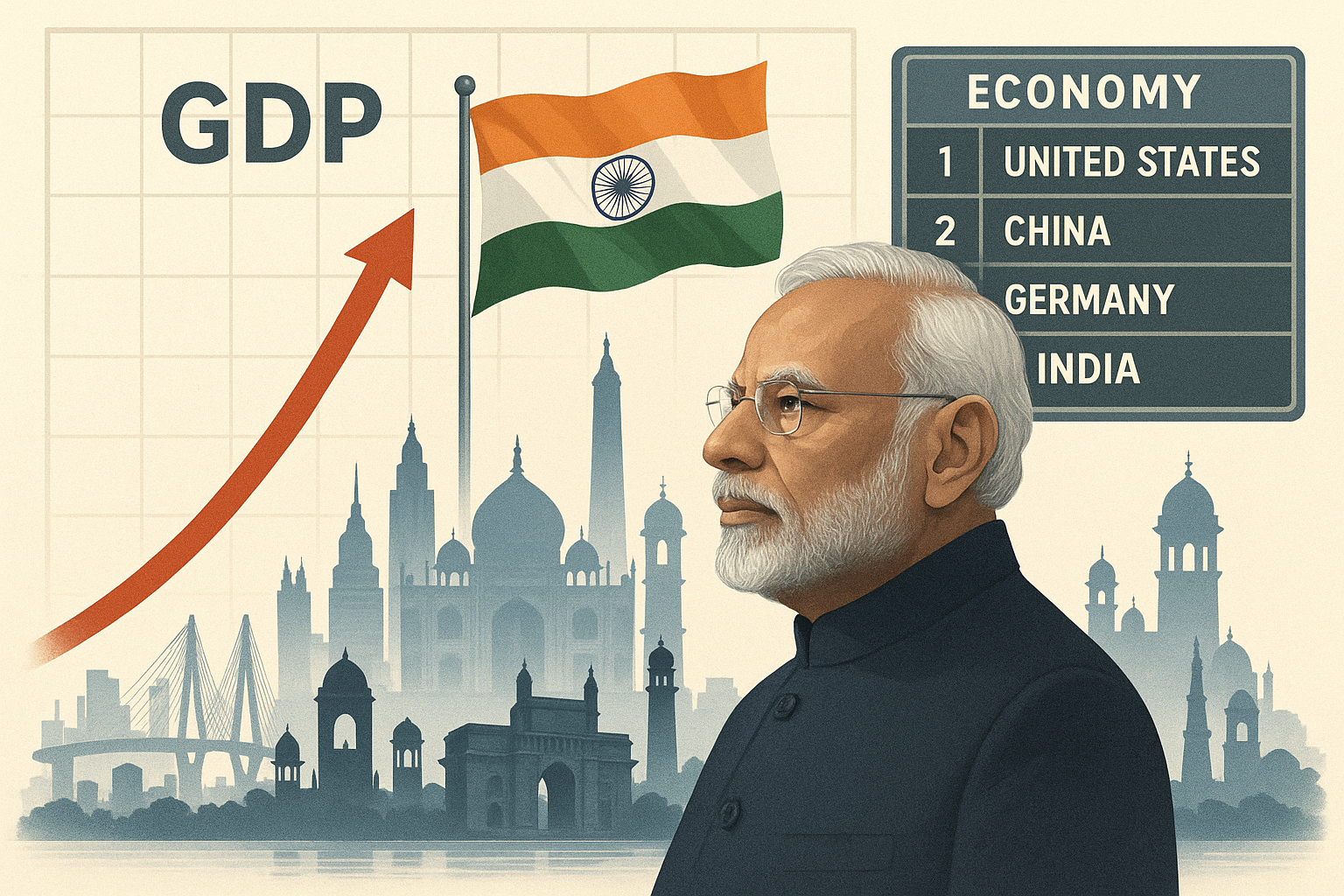
india economy has reached a symbolic milestone: India is now counted as the world’s fourth-largest economy by nominal GDP in several widely cited assessments. That is politically powerful news for Prime Minister Narendra Modi, whose government has made growth, infrastructure, and national prestige central to its public message. Still, turning this moment into a simple personal victory would be misleading. India’s rise reflects a mix of long-term demographic momentum, reforms spanning multiple governments, expanding domestic demand, and a favorable global reordering as advanced economies slow. Modi deserves some credit, but not all of it.
india economy and the meaning of fourth place
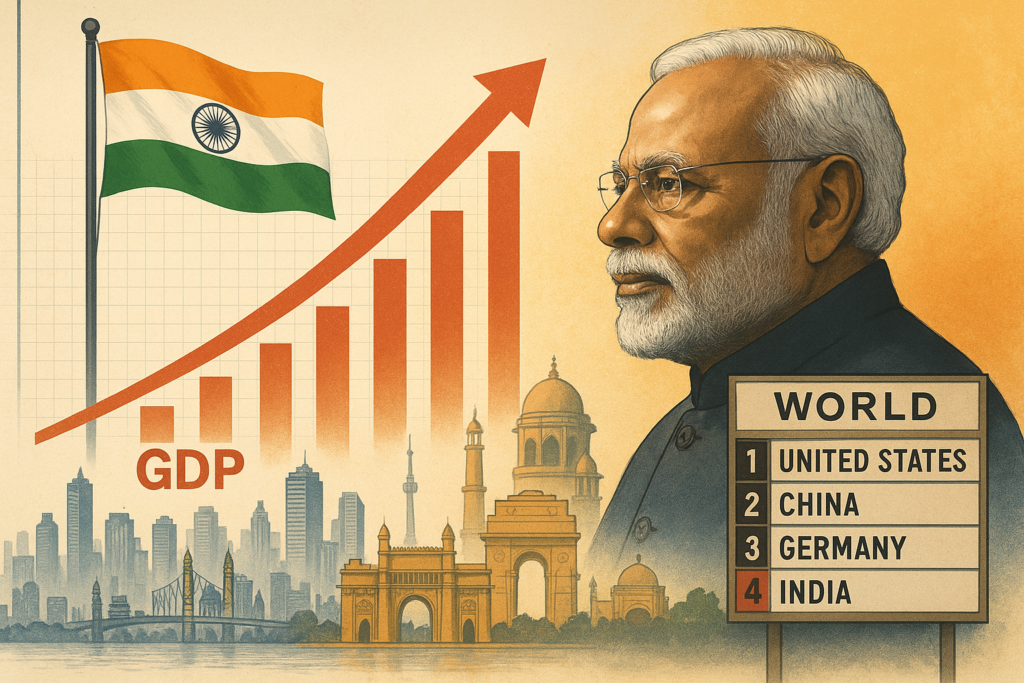
Ranking fourth is important, but the number needs context. A country can move up the global GDP table because its own economy grows fast, because another country grows slowly, because currencies move, or because inflation changes nominal values. India’s ascent says something real about scale: it is a vast market with a large labor force, rising consumption, and increasing state capacity in some sectors. But it does not mean India has solved deeper challenges such as low per capita income, uneven job creation, weak private investment cycles, and regional inequality. In other words, the headline is impressive, yet the underlying story remains more complex.
india economy: what Modi can legitimately claim
Modi’s supporters have a reasonable case when they point to visible state-led investment and execution. Since 2014, the central government has pushed road building, freight corridors, digital public infrastructure, electrification, welfare delivery through direct benefit transfers, and a more assertive manufacturing policy. The goods and services tax, despite its flaws, helped move India toward a more integrated national market. The insolvency and bankruptcy framework tried to tackle bad loans and corporate distress. Production-linked incentives aimed to draw global manufacturers into sectors such as electronics. These steps have not transformed India overnight, but they have improved formalization, logistics, and administrative reach.
Modi’s strongest contribution may be implementation, not invention
One of the strongest arguments in Modi’s favor is that his government has been better at scaling systems than many predecessors. India Stack, digital identity-linked service delivery, unified payments infrastructure, and broader digitization have changed how citizens, firms, and the state interact. Tax collection has broadened, welfare leakage has likely fallen in several schemes, and real-time digital payments have created a low-cost platform for commerce. The political message of efficiency matters too: investors often respond not only to reform laws but to whether a government appears capable of carrying them out.
Why the credit cannot belong to one leader alone
India’s economic rise did not begin in 2014. The foundations were laid over decades through liberalization in the 1990s, telecom expansion, growth in services exports, stronger financial institutions, rising educational attainment among parts of the workforce, and entrepreneurship across cities large and small. Earlier governments opened the economy, nurtured information technology, expanded infrastructure in stages, and created institutions that today’s economy still relies on. Demography also matters: India is one of the few major economies with a large and relatively young population, which naturally increases output over time when combined with urbanization and consumption growth.
External conditions have also helped. China’s growth has matured and slowed, Europe has struggled with weak demand, and Japan has faced long-running structural constraints. Multinational firms are diversifying supply chains, and India benefits from being seen as a large alternative market and production base. The country’s rank therefore reflects both domestic progress and relative shifts elsewhere. That does not reduce the achievement, but it does mean political narratives should avoid suggesting that one administration alone engineered a historic leap from nothing.
The limits of the Modi growth story
A balanced analysis must also acknowledge policy shocks and unfinished business. Demonetization disrupted the informal sector, where much of India’s employment still sits. The rollout of the GST was economically significant but administratively difficult for many small firms. Labor force participation, especially among women, remains a concern. Manufacturing has grown in pockets, yet India is still searching for the kind of broad-based export engine that powered East Asian success stories. Youth unemployment and underemployment continue to cast doubt on whether headline GDP growth is translating into enough quality jobs.
What fourth-largest status hides beneath the surface
Aggregate GDP is only one measure of economic health. India can be the fourth-largest economy and still remain far behind richer countries in income per person, productivity, health outcomes, and human development. Public infrastructure has improved, but learning losses, healthcare gaps, urban congestion, and agrarian distress remain serious constraints. Many households are still vulnerable to inflation and income shocks. Investors may celebrate India’s scale, yet sustained prosperity depends on deeper gains in skills, judicial efficiency, land markets, energy reliability, and labor-intensive industry. Without those, India risks becoming a huge economy that is still not broadly affluent.
So, how much credit goes to Modi?
The fairest answer is: a meaningful share, but not a dominant or exclusive one. Modi can claim credit for prioritizing infrastructure, pushing digital state capacity, branding India aggressively to investors, and keeping macroeconomic ambition at the center of politics. He has helped create the image of a government that wants scale and speed. But India’s climb is also the product of history, institutions, business adaptation, previous reforms, demographics, and the changing global economy. Any honest analysis should divide the credit across structural forces and successive governments rather than award it all to a single leader.
Final assessment for investors, voters, and observers
For investors, the key point is that India’s economic rise is real but still incomplete. For voters, the milestone offers a legitimate reason for pride, though not an excuse to ignore jobs, inequality, and social sector weaknesses. For observers of Modi, the bigger lesson is that political leadership matters most when it converts potential into durable capacity. On that test, his record is mixed but significant: stronger on execution and visibility, weaker on broad employment transformation. India becoming the world’s fourth-largest economy is therefore neither a myth nor a solo performance. It is a national achievement shaped by Modi, but larger than Modi.
- What Modi can claim: infrastructure expansion, digital governance, investor signaling, and administrative scaling.
- What predates Modi: liberalization, services growth, earlier institution-building, and entrepreneurial expansion.
- What remains unresolved: jobs, per capita income, manufacturing depth, and social development gaps.
Leave a Reply