
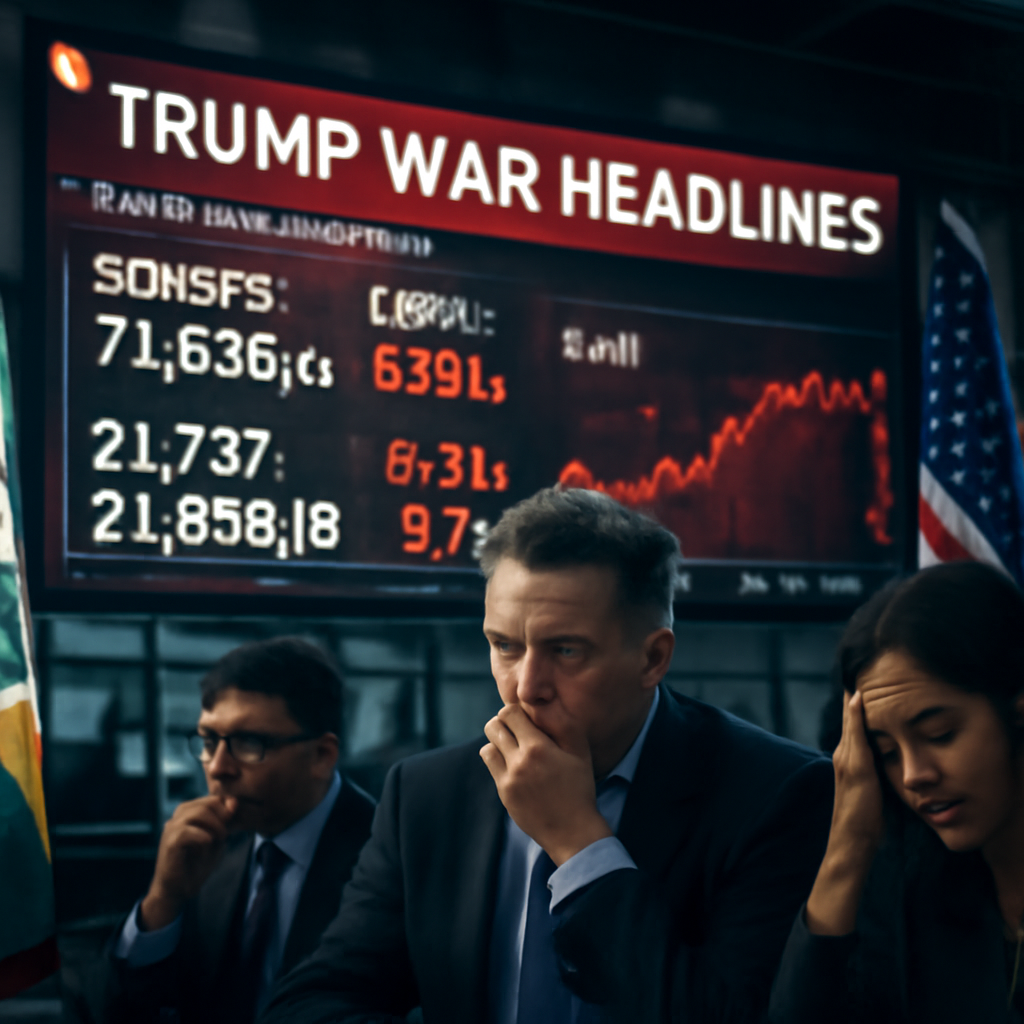
Trump war concerns dominated market sentiment on Monday 30th, 2026, as the Indian stock market opened the week under pressure from global risk-off cues, higher crude oil expectations, and renewed uncertainty around trade and geopolitical policy linked to Donald Trump’s aggressive rhetoric. Indian equities are highly sensitive to global shocks because foreign institutional flows, energy imports, export demand, and currency movements all quickly feed into valuations. While domestic macro indicators may remain relatively stable, any fear of escalation in US-led conflict, sanctions, tariff threats, or military action tends to trigger immediate caution in Mumbai’s trading rooms.
The biggest reason such headlines matter is that markets dislike uncertainty more than bad news itself. If investors believe a Trump-led conflict posture could widen into a broader war environment, then safe-haven assets usually gain while emerging markets face outflows. For India, the first transmission channels are typically crude oil, the rupee, bond yields, and foreign portfolio investor behavior. On a Monday session, that often translates into weak openings for benchmark indices like the Sensex and Nifty, followed by stock-specific volatility across banking, IT, metals, auto, and aviation counters.
Trump war and Indian market reaction
In practical market terms, the reaction pattern is usually easy to spot. Defensive sectors may hold up better, while rate-sensitive and economically exposed sectors can see sharper swings. If crude oil jumps on fears of supply disruption, oil marketing companies, paint firms, logistics players, airlines, and other fuel-linked businesses may come under pressure. At the same time, exporters can show mixed moves depending on whether the rupee weakens enough to support earnings, or whether fears of slower global demand cancel out any currency benefit. That is why the broad market response is never fully one-sided even when benchmark indices look weak.
Banking stocks are often the first domestic readout of investor confidence. A global war scare raises concerns around imported inflation, central bank flexibility, and the cost of capital. If oil stays elevated, inflation expectations rise, reducing hopes for easy monetary conditions. That can pressure banks and NBFCs due to concerns over margins, credit growth, and asset quality in vulnerable segments. Large private banks may remain relatively resilient compared with smaller financial names, but sentiment usually turns selective rather than broadly positive.
Trump war risks for key sectors
Energy, aviation, and autos
Among the most exposed sectors, energy-linked industries react fastest. India remains a major crude importer, so any war premium in oil creates a direct earnings and macroeconomic challenge. Aviation companies face higher fuel costs almost immediately, while auto makers can be hit through input cost pressure and weaker discretionary demand if inflation worries rise. Refiners and upstream companies may move differently depending on the exact price environment, government policy expectations, and refining margins. Investors therefore need to separate short-term trading moves from medium-term earnings effects.
IT, pharma, and exporters
IT stocks usually produce a more complex response. On one hand, a weaker rupee can support revenue translation for large software exporters. On the other hand, if a Trump-driven conflict atmosphere triggers recession fears or tighter corporate spending in the US, then technology budgets may face scrutiny. Pharma can behave defensively because of its stable demand profile, though US regulatory and pricing factors still matter. Specialty chemical and textile exporters may also see mixed movement depending on tariff noise, supply chain shifts, and how customers in the US and Europe react to the broader risk backdrop.
Trump war and investor strategy
For retail investors, the biggest mistake during a geopolitical shock is reacting emotionally to early headlines without understanding the chain of market effects. A one-day fall does not automatically mean a structural bear market, just as an intraday recovery does not confirm that risks are over. The better approach is to track a few leading indicators: Brent crude, USD/INR, foreign institutional investor activity, India VIX, US futures, and bond yield movement. These indicators often explain more about the day’s trend than social media panic or sensational television commentary.
Long-term investors should focus on balance sheet quality, earnings durability, and sector resilience. Companies with strong cash flows, pricing power, low leverage, and diversified demand tend to navigate war-driven volatility better than speculative names. Defensive allocation to quality pharma, select FMCG, and large-cap leaders can cushion portfolios, while staggered buying may make more sense than aggressive lump-sum entry on headline-driven dips. Traders, meanwhile, need tighter stop-loss discipline because geopolitical sessions are prone to sharp reversals, rumor-led swings, and gap openings.
What Monday 30th, 2026 could mean next
If tensions linked to Trump’s war posture persist beyond the session, the market will likely shift from shock pricing to scenario pricing. That means investors will begin asking more specific questions: Will crude remain elevated for weeks? Could new sanctions disrupt shipping or payment systems? Will the US dollar strengthen further? Could India’s import bill rise enough to change inflation expectations? Once markets move from headline fear to economic estimation, leadership within the market becomes clearer. Strong domestic themes may recover first, while globally exposed sectors can remain under pressure longer.
Another important factor is policy signaling from India. If domestic officials indicate confidence in supply arrangements, inflation management, and currency stability, that can calm nerves. The Reserve Bank of India, finance ministry commentary, and even measures around fuel pricing or trade logistics can influence sentiment. Global central bank language also matters because if war fears coincide with already cautious monetary conditions, risk assets face a double headwind. In contrast, if policymakers sound prepared and liquidity conditions remain stable, Indian equities may absorb the shock faster than other emerging markets.
Key signals investors should monitor
- Crude oil trend: a sustained rise hurts India’s macro outlook more than a temporary spike.
- Rupee movement: sharp depreciation can pressure imported inflation and market sentiment.
- FII flows: persistent foreign selling often deepens index weakness.
- India VIX: rising volatility signals fear and wider price swings.
- Sector rotation: defensives outperforming cyclicals usually confirms a cautious market tone.
It is also worth noting that the Indian market has historically shown resilience after global shocks, provided domestic growth remains intact and earnings estimates do not collapse. Short-term damage is often concentrated in valuations rather than business fundamentals, especially for high-quality companies. However, when war fears push oil higher and weaken global trade visibility at the same time, the adjustment can last longer. That is why investors should avoid assuming every dip is instantly buyable, while also resisting the temptation to abandon long-term plans purely because of one turbulent Monday.
Trump war outlook for Indian stocks
The near-term outlook for Indian stocks after Monday 30th, 2026 depends less on dramatic headlines and more on whether the feared conflict expands into a durable macro problem. If the issue stays limited to rhetoric and short-lived geopolitical stress, markets may rebound quickly with bargain hunting in banks, IT, and frontline large caps. But if the Trump war narrative evolves into sustained military escalation, tariff aggression, or prolonged commodity disruption, then earnings expectations and valuations may need to reset. For now, caution, selectivity, and close monitoring of global signals remain the most sensible stance for investors navigating this uncertain phase.
Leave a Reply