
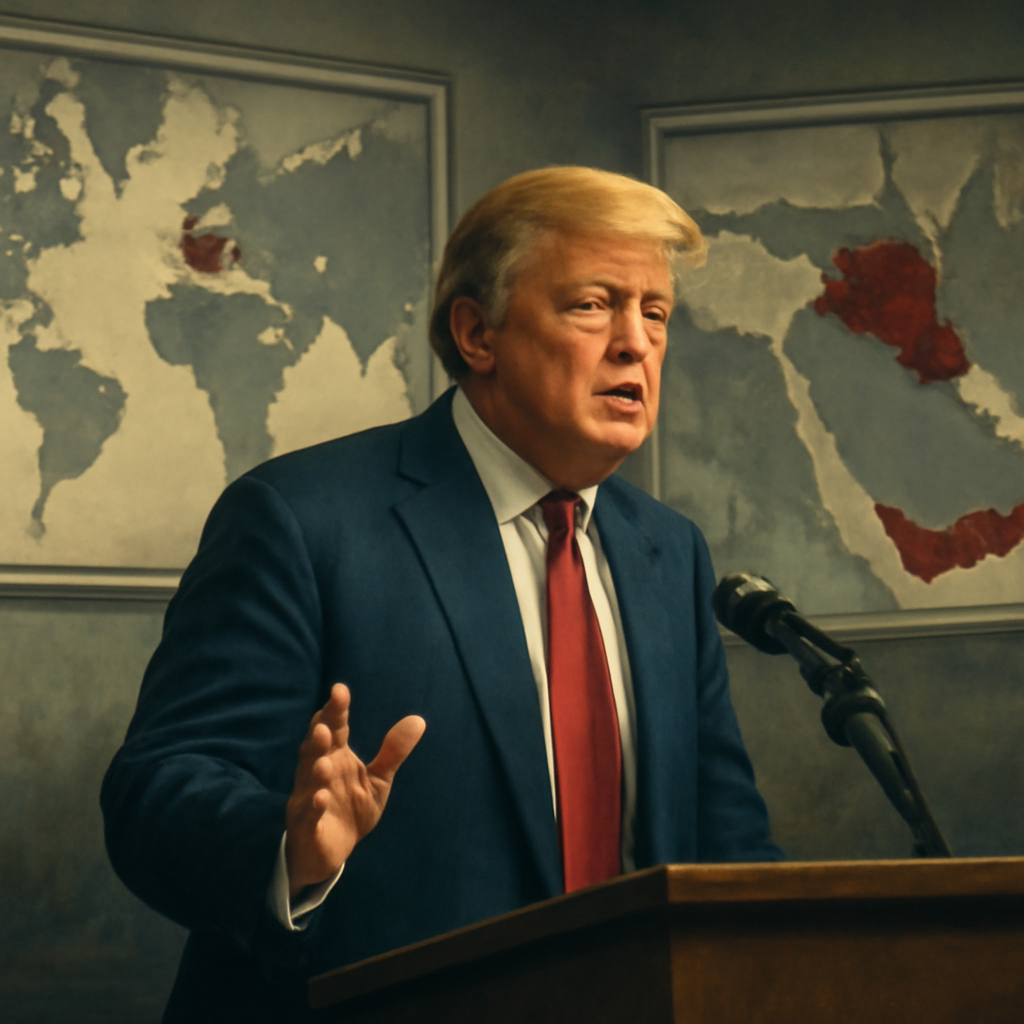
reducing wars was one of Donald Trump’s most repeated political promises, presented as proof that his style of leadership would calm global crises and keep the United States out of deeper military entanglements. That message resonated with voters tired of long wars and costly interventions. But the latest evidence from Ukraine, Gaza, and rising tension with Iran shows a far more complicated reality: the promise of quick de-escalation has not translated into clear results, and in some areas the risk of wider conflict remains high.
Trump and his allies have often argued that global adversaries were less aggressive during his first term and that his return to power would force settlements through pressure, deterrence, and personal diplomacy. Yet recent developments have undercut that simple narrative. Russia’s war in Ukraine continues without a negotiated breakthrough, Israel’s war in Gaza remains unresolved despite repeated calls for an endgame, and U.S.-Iran friction still threatens to spill into a broader regional confrontation. The political slogan was straightforward, but the international system has proved resistant to easy solutions.
reducing wars and the gap between rhetoric and results
The core problem for Trump’s argument is that campaign promises about war are easiest to make when they depend on assumptions about foreign leaders behaving predictably. In practice, they rarely do. Vladimir Putin has shown no sign of abandoning maximal goals in Ukraine simply because Washington changes tone. Hamas, Israel, Hezbollah, and regional powers all have their own calculations in the Middle East. A U.S. president can influence these conflicts, but cannot command them to stop on demand. That makes the promise of fast peace politically attractive but strategically fragile.
Supporters point to Trump’s image as a dealmaker and his preference for burden-sharing over direct intervention. Critics counter that his style often confuses coercion with diplomacy and leaves allies uncertain about U.S. commitments. That uncertainty can itself fuel instability. If partners doubt Washington’s consistency, they may act more aggressively on their own. If adversaries sense hesitation or mixed messaging, they may test limits rather than back down. In that environment, the goal of ending wars can be replaced by a more dangerous cycle of pressure, escalation, and delayed response.
reducing wars in Ukraine has not become reality
Ukraine is the clearest test of the promise. Trump repeatedly suggested that the war could be stopped quickly, often implying that his personal authority or negotiating skill would deliver what the Biden administration could not. But the war’s underlying realities remain unchanged. Russia still seeks strategic leverage and territorial advantage, while Ukraine insists that any durable peace must protect sovereignty and security. Those positions are not close, and no serious settlement appears imminent.
Even if Washington pushed harder for talks, there is little evidence that Moscow would accept a fair compromise without battlefield or economic pressure. Any settlement that rewards invasion could also destabilize Europe and invite future aggression. That means “peace” cannot be measured only by whether the shooting pauses for a moment. A rushed agreement that freezes conflict on Russian terms might reduce headlines in the short term while increasing the likelihood of renewed war later. For voters promised an end to conflict, that distinction matters.
reducing wars requires more than claiming leverage
Trump’s public language has often emphasized strength, unpredictability, and transactional bargaining. But durable peace efforts usually require patient alliance management, credible security guarantees, and sustained diplomatic engagement. In Ukraine, those ingredients are difficult and expensive. Simply asserting that the war would end faster under a different president does not amount to a plan. Without a publicly coherent framework for territorial issues, reconstruction, deterrence, and European coordination, the claim remains more political branding than demonstrated strategy.
The Gaza war exposes the limits of simple promises
The war in Gaza has presented another major challenge to the idea that Trump would be effective at reducing wars. The conflict has involved not just Israel and Hamas, but also hostages, humanitarian collapse, regional militias, and intense international pressure. There is no single switch Washington can flip to end it. Any U.S. approach must balance support for Israel, pressure for civilian protections, hostage diplomacy, Arab state interests, and the long-term question of Palestinian governance.
Trump’s broader Middle East posture has long leaned on forceful alignment with Israel and hard pressure on Iran and Iran-backed groups. That may satisfy a domestic political base, but it does not automatically produce de-escalation. In fact, highly one-sided signaling can narrow space for mediation. The result is that the promise to reduce war collides with the realities of a region where symbolic messages, military deterrence, and diplomacy all interact. Strong rhetoric can project confidence, but it does not by itself build a ceasefire framework.
Why regional escalation still matters
One reason this promise remains unfulfilled is that the Gaza conflict has never been isolated. Hezbollah exchanges on the Lebanon border, Houthi attacks affecting shipping routes, militia threats against U.S. positions, and Israeli-Iranian shadow conflict all raise the possibility of a wider war. An administration serious about reducing wars must lower those overlapping risks, not just react to them. So far, the broader Middle East picture suggests persistent instability rather than a decisive turn toward peace.
Iran tensions complicate the anti-war message
Iran is another area where Trump’s record and political messaging cut against the image of a leader reliably reducing conflict. His supporters argue that maximum pressure constrained Tehran. Critics argue that abandoning established diplomatic channels increased long-term danger while failing to create a durable alternative. Today, with proxy networks active across the region and mistrust deep on all sides, the U.S.-Iran relationship remains one of the most combustible flashpoints in global politics.
That matters because reducing wars is not only about ending active battlefields. It is also about preventing dormant crises from exploding. If U.S. policy relies heavily on threats without a parallel diplomatic track, escalation risks increase. A strategy designed around deterrence can be necessary, but deterrence alone rarely resolves underlying disputes. The campaign claim implied a calmer world; the current reality still includes multiple pathways to a larger confrontation.
What voters were promised versus what the record shows
Trump’s political advantage on this issue came from framing himself as the candidate of restraint compared with more interventionist rivals. That message had real appeal after decades of war fatigue in the United States. However, avoiding large new invasions is not the same as successfully reducing wars already underway or preventing fresh crises from expanding. On that narrower and more important test, the evidence is weak. The world has not bent to the promise.
- Ukraine remains locked in a grinding war with no credible fast settlement.
- Gaza continues to generate humanitarian and strategic fallout across the region.
- Iran-linked tensions still threaten U.S. interests and regional stability.
- Claims of quick peace have not been matched by detailed, workable plans.
For many voters, the issue is no longer whether the promise sounded appealing. It is whether it was realistic and whether the outcomes support it. Recent events suggest they do not. Foreign policy rewards patience, consistency, and credible diplomacy more than campaign-era certainty. A promise to reduce wars can win applause, but it must ultimately be judged by conflict trends, alliance confidence, and whether violence actually declines.
The political cost of an unmet foreign policy promise
If Trump continues to campaign on this theme, he will face growing scrutiny over the difference between branding and delivery. Opponents will argue that he oversold his ability to force settlements and understated the complexity of modern conflict. Even some sympathetic voters may ask why the promised peace dividend has not appeared. The broader lesson is that war is not reduced by slogan alone. It requires strategy that aligns military power, diplomacy, allied trust, and realistic goals. On that central promise, Trump has not shown that he can deliver the outcome he repeatedly advertised.
Leave a Reply