
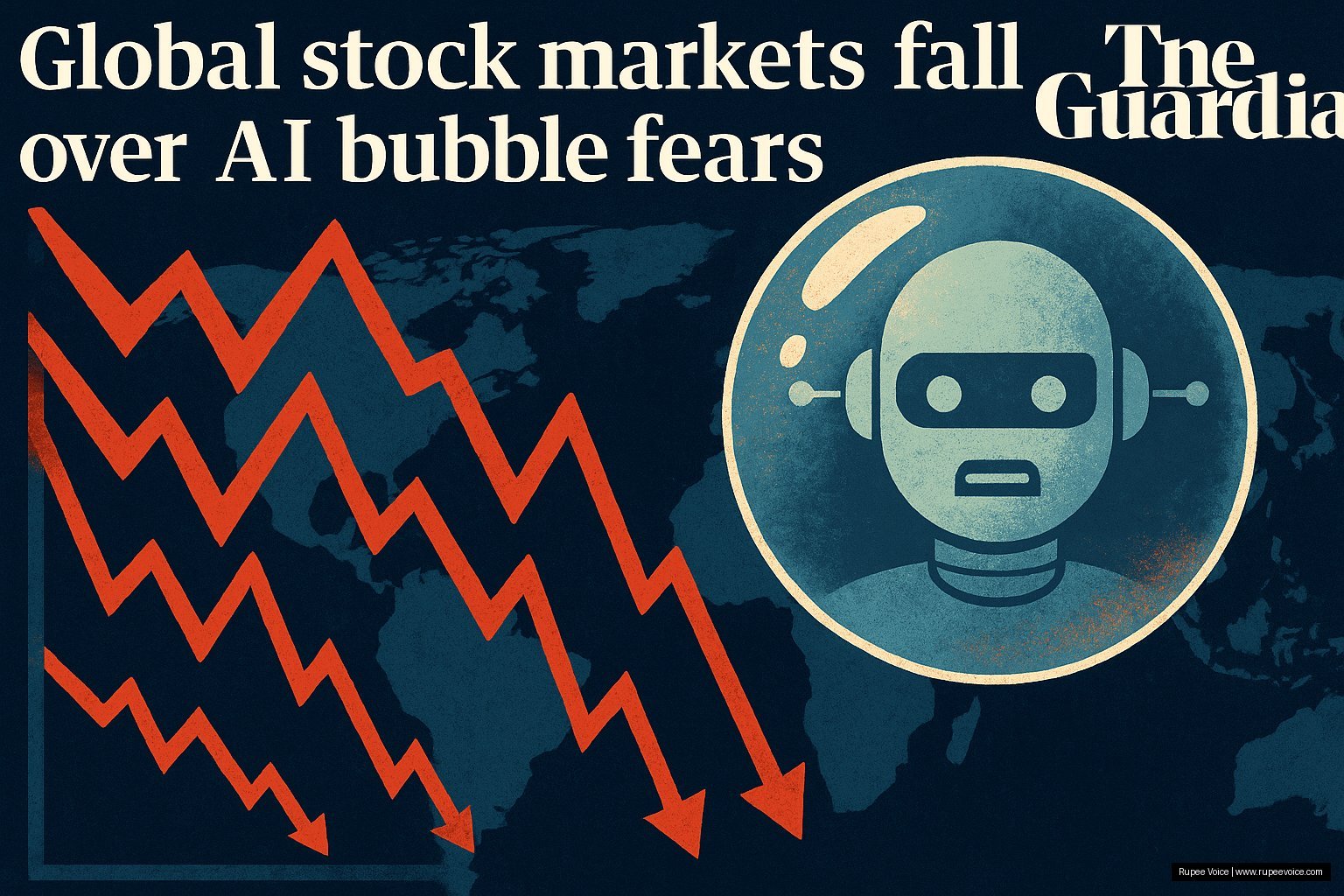
Global stock markets fall sharply over AI bubble fears
What happened
– A risk-off selloff swept global equities as investors questioned whether artificial intelligence-linked valuations have run ahead of fundamentals. The Guardian reported a broad decline across major markets amid growing “AI bubble” worries.
– The pullback hit US mega-cap tech and the AI supply chain (semiconductors, chip equipment, cloud/data-centre plays) and spilled over to Europe and Asia.
– In India, technology and growth-oriented stocks underperformed, while defensives held up relatively better.
Why markets are nervous
– Stretched valuations: Several AI leaders have been trading well above long-term averages, leaving little room for disappointment if revenue growth or margins slow.
– Momentum fatigue: A narrow market led by a handful of AI beneficiaries has heightened fragility; when leaders wobble, passive and momentum flows can amplify downside.
– Capex-cycle questions: Any signs of order pushouts in data centres, slower cloud spending, or inventory build in semis can quickly reset expectations.
– Macro backdrop: Higher-for-longer policy rates and tighter financial conditions raise discount rates for long-duration growth stocks, pressuring multiples.
Where the pressure showed up
– US: AI bellwethers and the Nasdaq-led complex underperformed; broader indices weakened as correlations rose.
– Europe: Semiconductor and equipment names, plus luxury/cyclicals tied to global growth, faced selling.
– Asia: Tech-heavy indices and suppliers to the US AI ecosystem declined; Japan and Taiwan semis were in focus.
– India: Nifty IT underperformed the headline indices; broader risk aversion weighed on high-beta pockets. INR and bond yields are key second-order variables to watch if foreign flows turn negative.
Why it matters for Indian investors
– Earnings sensitivity: Indian IT services revenue is linked to US/Europe tech and enterprise spending; a prolonged rethink of AI capex or discretionary tech budgets would filter into guidance.
– Flows and currency: Global de-risking can trigger foreign portfolio outflows from India, add pressure on the rupee, and lift import costs—affecting sectors with USD-linked inputs.
– Valuation discipline: Elevated multiples in select Indian growth names leave them vulnerable to global multiple compression.
What to watch next
– Guidance and orders: Updates from US hyperscalers, chipmakers, and equipment firms on data-centre orders, AI GPU supply, and capex timelines.
– Market breadth: If selling broadens beyond AI leaders or improves after an initial shakeout.
– Rates and liquidity: Moves in US yields and dollar strength; these often set the tone for risk assets.
– India-specific signals: Nifty IT commentary, deal wins, pricing, and hiring trends; FPI flow data; INR and crude oil trajectory.
How to navigate (not investment advice)
– Rebalance, don’t panic: Consider whether AI-linked exposures have grown outsized versus your plan; gradual rebalancing can reduce concentration risk.
– Quality filter: Within tech, favour strong balance sheets, durable cash flows, and clear monetisation paths over speculative narratives.
– Diversification: Blend cyclicals/defensives and maintain asset-class diversification (equity, fixed income, gold) appropriate to your horizon and risk tolerance.
– SIP discipline: For long-term investors, systematic allocations can benefit from volatility without trying to time the bottom.
Context: Is there an AI bubble?
– The AI build-out is real (productivity tools, inference at scale, edge use-cases), but market pricing can overshoot during early adoption phases.
– Historically, transformative tech cycles (e.g., early internet, smartphones) saw boom-bust in equity pricing even as the underlying technology progressed. Differentiating enduring cash flow creators from “capex passengers” is critical.
Attribution: Based on reporting by The Guardian; analysis and India-focused context by our newsroom.
Leave a Reply